



















The Universal Credit loophole £1500 is not a secret Department for Work and Pensions payment, government bonus or legitimate trick that allows every claimant to receive an extra £1,500.
The phrase has circulated online because of confusion between genuine Universal Credit advance payments and an older problem involving fraudulent advance claims.
A person receiving Universal Credit may legitimately qualify for an advance in certain circumstances.
However, the amount is based on the claimant’s circumstances, it is normally repayable and there is no rule guaranteeing £1,500.
The £1,500 figure also has an important historical connection. During investigations into Universal Credit advance fraud in 2019, the DWP used figures of £1,000 and £1,500 when estimating the average financial value of potentially fraudulent advance claims.
That historical figure should not be confused with a payment available to claimants today.
What Is the Universal Credit Loophole £1500?
The expression normally refers to claims circulating online that somebody receiving Universal Credit can obtain approximately £1,500 by requesting an advance or using a particular method when completing their claim.
That description is misleading.
There is no official Universal Credit rule called the £1,500 loophole, and the DWP does not publish a special £1,500 payment that can be unlocked by using particular wording in a Universal Credit journal.
There are legitimate forms of financial help available through Universal Credit, including advances. However, each has eligibility rules, limits and repayment requirements.
The danger comes when legitimate advance payments are presented online as free money.
Where Did the £1,500 Universal Credit Figure Come From?
One reason the figure continues to appear online is the history of Universal Credit advance fraud.
After online applications for advances became available, the DWP identified a substantial number of suspicious claims during 2018 and 2019.
Some cases involved false information being used to increase advance payments, while others involved people’s identities being used by third parties.
By the end of December 2019, the DWP had identified 97,780 suspected advance-fraud cases.
When estimating the amount of money potentially at risk, the department used average advance values of £1,000 and £1,500.
That is an important distinction.
The £1,500 figure was used as part of a historical estimate of suspected fraudulent advances. It was not the creation of a £1,500 Universal Credit entitlement.
Is There a £1,500 Universal Credit Payment in 2026?
No standard £1,500 Universal Credit payment exists in 2026.
Universal Credit is calculated according to the claimant’s household circumstances. Factors such as age, children, housing costs, earnings, health-related elements and other income can affect the final monthly award.
Two claimants can therefore receive very different amounts.
There is no rule stating that someone can request £1,500 simply because they receive Universal Credit.
A claimant should be particularly cautious about social-media posts using expressions such as “DWP loophole”, “guaranteed £1,500”, “free government money” or “secret UC payment”.
Can Someone Get £1,500 as a Universal Credit Advance?
Potentially, but this is very different from receiving a £1,500 bonus.
Someone waiting for their first Universal Credit payment may be able to request a first-payment advance if they need help covering bills or other costs.
The maximum first-payment advance is based on the claimant’s estimated first Universal Credit payment.
There is therefore no universal £1,500 maximum or entitlement.
For example, if someone’s estimated first Universal Credit award were £900, they would not become entitled to a £1,500 first-payment advance merely by requesting it.
If another household had an estimated award of £1,500 or more because its circumstances produced a larger Universal Credit entitlement, the potential advance could be correspondingly higher.
The important point is that the money represents an advance against Universal Credit rather than an additional award.
Does a Universal Credit Advance Have to Be Repaid?
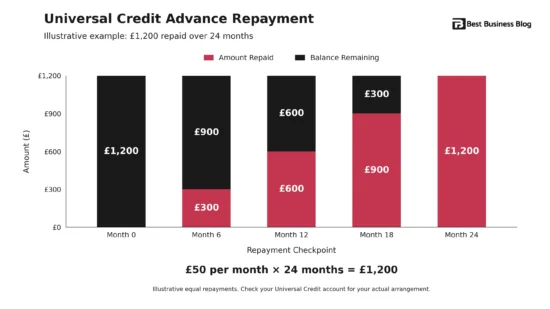
Yes. A first-payment Universal Credit advance is normally recovered through deductions from later Universal Credit payments.
Current rules generally allow repayment over 24 months.
This can provide useful short-term help during the approximately five-week period before a claimant receives their first regular Universal Credit payment, but it can also reduce the amount available in subsequent months.
For example, someone borrowing £1,200 and repaying it evenly over 24 months would effectively face deductions averaging £50 per month, although the actual repayment arrangement should always be checked on the claimant’s Universal Credit account.
Someone struggling with repayments may be able to ask for first-payment advance repayments to be delayed temporarily.
Is a Budgeting Advance the £1,500 Loophole?
No. A Budgeting Advance is another legitimate form of Universal Credit support, but its current limits are substantially below £1,500.
| Household situation | Maximum Budgeting Advance |
| Single claimant | £348 |
| Couple | £464 |
| Claimant or couple with children | £812 |
The minimum amount that can normally be borrowed is £100.
A Budgeting Advance is intended for certain one-off expenses rather than everyday living costs. Examples can include essential household items, clothes, home repairs, funeral expenses, removal costs or a tenancy deposit.
It cannot normally be used simply to pay routine food costs, ordinary household bills, rent or existing debts.
Eligibility also depends on circumstances. A claimant will normally need to have received Universal Credit or another qualifying benefit for at least six months unless the money is required to start or remain in work.
Someone who has earned more than £2,600 during the previous six months, or £3,600 for a couple, will normally not qualify. An existing Budgeting Advance generally has to be repaid before another can be obtained.
Budgeting Advances are usually repaid through future Universal Credit payments over 24 months.
Is £1,500 a Universal Credit Savings Loophole?
No. £1,500 is not one of the main Universal Credit capital thresholds either.
For most Universal Credit claims, savings and other countable capital below £6,000 do not reduce the award.
Capital between £6,000 and £16,000 can reduce Universal Credit. The standard calculation assumes monthly income of £4.35 for each £250, or part of £250, held above £6,000.
Someone with more than £16,000 in countable capital will usually not qualify for Universal Credit, although special rules and temporary disregards can apply in particular circumstances.
Therefore, somebody seeing claims online that £1,500 can be hidden, transferred or moved to exploit a “savings loophole” should not rely on them.
Claimants are required to report relevant money, savings and investments accurately.
What Happens If Someone Suddenly Receives £1,500?
The treatment depends on what the payment actually represents.
Receiving £1,500 does not automatically remove entitlement to Universal Credit. The DWP needs to determine whether the money is earnings, capital, an advance, compensation, a benefit payment, a refund or another type of payment.
Income can eventually become savings if it remains unspent beyond the relevant assessment periods.
Larger payments such as inheritances, redundancy payments, pension lump sums and compensation can also affect the amount of capital a claimant holds.
For example, somebody leaving employment may need to consider both Universal Credit capital rules and the separate tax treatment of redundancy payments.
The safest approach is therefore to report relevant changes rather than assuming a payment does not count.
Can Someone Spend Savings to Stay Below the Universal Credit Limit?
Spending money is not automatically prohibited simply because somebody receives Universal Credit.
People still need to pay ordinary living costs, replace essential items, repay certain debts and make reasonable financial decisions.
The problem arises where someone deliberately reduces or disposes of capital primarily to increase or obtain Universal Credit. This can potentially be treated as deprivation of capital.
For example, transferring thousands of pounds to another person while continuing to benefit from the money could cause difficulties if the DWP concludes that the claimant intentionally deprived themselves of capital.
There is therefore no legitimate method of moving £1,500, £6,000 or any other amount around purely to manipulate Universal Credit entitlement.
Does Working Create a Universal Credit Loophole?
Working does not automatically end Universal Credit.
Universal Credit is designed to adjust according to earnings. Under the current standard taper, Universal Credit normally falls by 55p for each £1 of earnings taken into account above any applicable work allowance.
Some households with children or a qualifying health condition receive a work allowance before the taper starts.
For 2026/27, the monthly work allowance is £427 where Universal Credit includes help with housing costs and £710 where it does not.
That means people can legitimately work and continue receiving Universal Credit where their overall circumstances still produce an award.
This is part of the normal benefit calculation, not a loophole.
What About Self-Employed Universal Credit Claimants?
Self-employed people can also receive Universal Credit, but additional reporting rules apply.
A self-employed claimant will normally need to report business income and allowable expenses for each monthly assessment period.
After any applicable start-up period, the Minimum Income Floor can also affect some established self-employed claimants. This can mean Universal Credit is calculated using an assumed level of earnings even where the business actually earns less during the month.
A sole trader should therefore be particularly cautious about advice suggesting that moving business receipts between accounts or delaying declarations can increase Universal Credit.
Operating business accounts and legitimate business assets can receive different treatment from personal savings in some circumstances, but business income still needs to be reported correctly.
How Can £ 1,500 Universal Credit Scams Work?
The most dangerous version of the £1,500 loophole claim involves an unofficial person offering to obtain money for a claimant.
A typical scam may involve someone promising a guaranteed advance, asking for access to the claimant’s Universal Credit account, submitting false information and then demanding part of the resulting payment as a fee.
The claimant can be left with two problems: the third party may take hundreds of pounds, while the claimant remains responsible for the resulting debt or overpayment.
Common warning signs include:
- A guaranteed £1,500 payment regardless of circumstances.
- Requests for Universal Credit usernames, passwords or security codes.
- Someone asking to change the bank account receiving Universal Credit.
- A fee based on a percentage of the advance.
- Advice to provide false rent, childcare, employment or household information.
- Claims that the DWP cannot recover the money.
- Pressure to act quickly before a supposed loophole closes.
A genuine Universal Credit advance does not require handing an online account to an unofficial “agent”.
What Happens If False Information Is Used to Get an Advance?
Providing inaccurate information can create an overpayment.
If Universal Credit has been overpaid, the DWP can normally seek repayment. The position does not automatically disappear because the money has already been spent.
Where deliberate dishonesty is suspected, the situation can become more serious and potentially lead to a benefit-fraud investigation, financial penalties or prosecution depending on the circumstances.
This is why a supposed loophole that produces money initially can create a much larger financial problem later.
What Should Someone Do If an Online Agent Has Already Used Their Universal Credit Account?

The claimant should regain control of the account as quickly as possible.
Passwords and associated email credentials should be changed where necessary. Suspicious activity should be reported through the Universal Credit account or directly to the appropriate DWP service.
The claimant should also check whether their payment bank details, address, rent information, household information or other circumstances were changed without permission.
Bank statements should be reviewed for unusual transfers.
Where identity information has been stolen or a third party has taken money, the matter may also need to be reported to the bank and the appropriate fraud-reporting service.
It is particularly important not to ignore a suspicious advance simply because the claimant did not personally complete the application.
What Legitimate Financial Help Is Available Instead?
A claimant experiencing financial difficulty should use the established support routes rather than searching for a loophole.
Depending on the circumstances, help may include a first-payment advance, Budgeting Advance, hardship payment, support following a change of circumstances, help with certain work-related expenses, local council support or assistance with eligible childcare costs.
The correct option depends on why the money is needed.
An advance can solve an immediate cash-flow problem, but the effect of future deductions should always be considered before borrowing the maximum available amount.
Is the Universal Credit £1,500 Loophole Worth Trying?
No. There is no legitimate reason to use an unofficial “loophole” when the Universal Credit system already provides formal routes for requesting advances and other financial support.
A genuine advance is based on eligibility and personal circumstances. It can provide valuable emergency cash, but it creates a repayment obligation.
A method that relies on hiding savings, inventing expenses, manipulating household information or providing false evidence is not a loophole. It risks creating an overpayment and potentially much more serious consequences.
Frequently Asked Questions
Is the Universal Credit £1,500 loophole real?
No. There is no official DWP loophole that guarantees an extra £1,500 Universal Credit payment.
Can Universal Credit give someone a £1,500 advance?
It may be possible for a first-payment advance to reach £1,500 where the claimant’s estimated first Universal Credit award supports that amount. It is not a standard entitlement and normally has to be repaid.
Is £1,500 free money from the DWP?
No. A legitimate Universal Credit advance is normally recovered from future benefit payments.
What is the maximum Universal Credit Budgeting Advance?
The current standard maximum is £348 for a single claimant, £464 for a couple or £812 where the claimant or couple has children.
Is £1,500 the Universal Credit savings limit?
No. Savings below £6,000 normally have no effect on Universal Credit, while capital between £6,000 and £16,000 can reduce an award. Capital above £16,000 usually prevents entitlement.
Where did the £1,500 Universal Credit rumour come from?
The figure has been associated with historic advance-payment fraud and later online claims describing legitimate advances as a secret way of receiving free government money.
Can the DWP ask for a fraudulent advance back?
Yes. Universal Credit overpayments can be recoverable. Deliberately giving false information can also lead to further investigation or penalties.
Does receiving £1,500 into a bank account automatically stop Universal Credit?
No. The effect depends on what the payment represents and the claimant’s overall circumstances. Relevant changes in income, money, savings or investments should be reported correctly.
Can someone pay an agent to get a larger Universal Credit advance?
Using an unofficial person who asks for login details or promises a guaranteed payment is risky. Claimants should apply through their Universal Credit account, work coach or other official route.
Is there any legal Universal Credit loophole?
There is no need for one. Universal Credit contains legitimate rules covering work allowances, advances, capital disregards and other support, but these are normal parts of the benefit system rather than hidden loopholes.