

















Last Updated: 10.10.2026
Most train tickets in the UK are zero-rated for VAT, which means VAT applies at a rate of 0% rather than the standard 20% rate.
For an ordinary passenger buying a train ticket, this means there is normally no VAT amount added to the fare.
For a VAT-registered business, it also means there is usually no input VAT available to reclaim on the rail fare itself.
However, the VAT treatment becomes more complicated when a booking contains extras such as booking fees, station parking, food, sleeper accommodation or other services.
International journeys, charter trains and travel costs recharged to clients can also require different treatment.
The position for 2026 therefore depends not simply on whether a payment relates to a train, but on what service is actually being supplied.
Key Points
- Most Ordinary UK Train Fares Are Zero-Rated At 0%
- Zero-Rated Does Not Mean VAT Exempt
- Most Businesses Cannot Reclaim VAT On The Rail Fare Because The VAT Charged Is £0
- First-Class Tickets Normally Follow The Same Passenger Transport Rules
- Separate Booking Fees, Parking And Catering Can Have Their Own VAT Treatment
- International Rail Journeys Can Involve Different Place Of Supply Rules
- Businesses Should Keep Tickets, Receipts And Booking Confirmations Even When No VAT Is Reclaimed
How Is VAT Calculated On Train Tickets?
VAT on train tickets is not normally calculated by taking 20% of the ticket price.
Instead, HMRC first considers the type of supply. Passenger transport supplied in the UK can be zero-rated, reduced-rated or standard-rated depending on the circumstances.
For most ordinary UK rail journeys, the passenger transport qualifies for the zero rate. This means a £50 qualifying rail fare has VAT applied at 0%.
The calculation is therefore:
| Train Fare | VAT Rate | VAT Amount | Total |
| £50 | 0% | £0 | £50 |
| £100 | 0% | £0 | £100 |
| £250 | 0% | £0 | £250 |
The ticket becoming more expensive does not cause it to move into the 20% VAT rate.
A £200 first-class fare can still be zero-rated in the same way as a £30 standard-class fare if both represent qualifying passenger transport.
How HMRC Classifies Passenger Transport?
HMRC treats a passenger transport service as one where a vehicle, ship or aircraft is provided with a driver or crew to carry passengers.
For VAT purposes, HMRC specifically includes trains within the meaning of a vehicle.
This distinction matters because hiring a means of transport without a driver or crew is not necessarily treated in the same way as purchasing passenger transport.
The key issue is therefore the nature of the service being provided rather than the name appearing on the ticket.
How The 10-Passenger Rule Affects VAT?
Domestic passenger transport can generally qualify for zero rating when it is supplied in a vehicle, ship or aircraft designed or adapted to carry at least 10 passengers, including seats for the driver and crew.
Normal passenger trains comfortably meet this requirement.
This is one reason rail travel is commonly zero-rated while transport in smaller vehicles can have a different VAT treatment.
The rule is particularly important when comparing train travel with taxis, private hire cars and other smaller forms of passenger transport.
Does VAT Apply To Every Type Of Train In The UK?
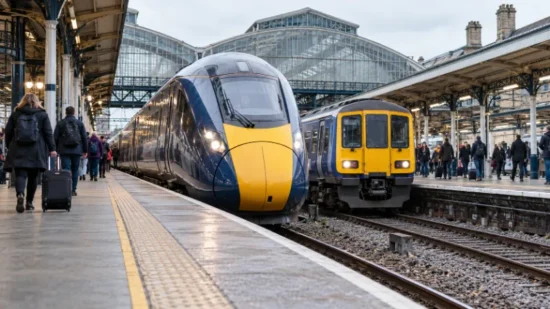
Not every service involving a train automatically receives identical VAT treatment.
The important question is whether the payment represents qualifying passenger transport or another type of supply.
Standard, First-Class And Sleeper Trains
Ordinary standard-class and first-class rail fares are normally treated in the same way for VAT purposes.
First class does not automatically attract 20% VAT simply because the ticket is more expensive or provides a higher standard of seating.
Sleeper trains can also fall within the passenger transport rules.
Where sleeping accommodation is supplied as an incidental part of the passenger journey, the associated charge can follow the VAT treatment of the transport.
Businesses should still check how separate services are shown on the booking documents.
Heritage, Steam And Charter Trains
Heritage and steam railways are not automatically subject to 20% VAT.
HMRC specifically recognises qualifying excursions by train, including steam railways, within its passenger transport rules.
However, the position can become different where the main product is effectively an entertainment, hospitality or admission experience rather than straightforward passenger transport.
For example, a package involving a luxury meal, entertainment and a railway experience could require closer consideration than a simple ticket carrying passengers between locations.
Chartering a train also does not automatically make the journey standard-rated. The VAT treatment depends on the actual supply and whether it meets the conditions for qualifying passenger transport.
Why Are Most UK Train Tickets Zero-Rated?
UK VAT rules give zero-rated treatment to qualifying public passenger transport.
This is why the usual VAT rate on an ordinary domestic train fare is 0%.
A zero-rated ticket remains within the VAT system. It is simply taxed at 0%.
That distinction is especially important for VAT-registered businesses because zero-rated purchases and exempt purchases should not automatically be treated as the same thing in accounting records.
Zero-Rated VAT vs VAT Exempt
The terms are often used interchangeably in everyday conversation, but they have different meanings for VAT.
Zero-rated means:
- The Supply Is Taxable
- The VAT Rate Is 0%
- No Positive VAT Amount Is Added To The Fare
VAT exempt means:
- The Supply Falls Within An Exemption
- It Is Treated Differently From A Zero-Rated Taxable Supply
Therefore, saying that train tickets are simply “VAT exempt” is generally inaccurate when discussing ordinary qualifying UK rail fares.
The more accurate description is that most train tickets are zero-rated for VAT.
Can Businesses Reclaim VAT On Train Tickets?
A VAT-registered business normally cannot reclaim VAT on an ordinary train fare because there is no positive VAT amount to reclaim.
For example, suppose an employee travels from Manchester to London for a client meeting and the rail ticket costs £120.
The business may record:
- Travel Expense: £120
- Input VAT: £0
- Total Cost Recorded: £120
The entire £120 can still represent a business travel cost even though there is no VAT to recover.
This is an important distinction. Claiming a cost as a business expense and reclaiming VAT are two separate questions.
The same principle applies to self-employed people. Travel costs can have their own rules depending on whether a journey is genuinely for business purposes.
Businesses comparing different travel methods may also find it useful to understand how self-employed vehicle and travel costs are treated, particularly where rail and road travel are both used for work.
How To Record Train Travel In Business Accounts?
Businesses should normally record the full zero-rated rail fare as a travel expense with £0 VAT reclaimed.
If the booking contains several different charges, those amounts may need to be separated.
For example:
| Cost | Amount | Possible VAT Treatment |
| Train Fare | £100 | Usually 0% |
| Booking Fee | £6 | Check Invoice |
| Station Parking | £15 | May Carry VAT |
| Food | £12 | May Carry VAT |
| Total Paid | £133 | Mixed Treatment Possible |
Do not assume the entire £133 has the same VAT treatment simply because everything relates to one business trip.
Accurate records become particularly important if HMRC checks a VAT return. A VAT investigation or compliance check can include examination of purchase records, VAT invoices and evidence supporting input VAT claims.
Can You Get A VAT Receipt For A Train Ticket?
A train ticket, booking confirmation and VAT invoice are not necessarily the same document.
Because an ordinary rail fare is normally zero-rated, there may be no positive VAT amount to show on the ticket.
A passenger can still receive a receipt or booking confirmation showing:
- Journey Details
- Ticket Price
- Date Of Purchase
- Travel Date
- Payment Method
- Booking Reference
That can be useful evidence for a company’s expense records even where no VAT is available to reclaim.
Train Tickets, Expense Receipts And VAT Invoices
Businesses should distinguish between:
Train Ticket: Evidence that the passenger has the right to travel.
Expense Receipt: Evidence showing how much was paid for the journey.
VAT Invoice: A document containing the information needed to support a VAT claim where VAT has actually been charged.
A business should not assume that having a receipt automatically creates a VAT reclaim.
For example, if a receipt shows a £90 zero-rated train fare and no VAT amount, the company should not calculate 20% VAT backwards from the £90.
Does Trainline Charge VAT On Train Tickets?
Buying a ticket through Trainline or another booking platform does not normally change the VAT treatment of the underlying qualifying UK rail fare.
If the train fare itself is zero-rated, purchasing the same journey through an intermediary does not normally turn that fare into a 20% VAT supply.
However, a separate service or booking fee charged by the booking platform may have a different VAT treatment.
Trainline Booking Fees And VAT
Suppose a business booking shows:
- Rail Fare: £75
- Booking Fee: £3
- Total: £78
The £75 rail fare may be zero-rated while VAT may apply separately to the booking fee depending on how the supplier has invoiced the transaction.
Businesses should therefore inspect the receipt rather than applying a single VAT rate to the entire booking.
This distinction becomes particularly important where multiple employees travel frequently and booking fees add up across hundreds of transactions.
Is There VAT On Season Tickets And Railcards?
A season ticket used for qualifying rail passenger transport generally follows the VAT treatment of the underlying passenger transport.
The fact that the passenger purchases several weeks, months or a year of travel in advance does not by itself make ordinary qualifying rail travel subject to the standard VAT rate.
Railcards require separate consideration because the amount paid for a discount card is not necessarily the same supply as the rail journey subsequently purchased with it.
A business paying for employee railcards should therefore check the documentation relating to the railcard itself rather than automatically recording it using the same treatment as the train fare.
This is especially important where one transaction contains a railcard, ticket and booking charge.
Is There VAT On Eurostar And International Train Tickets?
International rail travel requires an additional consideration because UK VAT depends partly on where the passenger transport physically takes place.
Where a journey takes place both inside and outside the UK, the part occurring within the UK can fall within UK VAT rules while the overseas part is outside the scope of UK VAT.
Qualifying international passenger transport within the UK can be zero-rated.
This means a London-to-Paris journey should not simply be treated as though the entire journey were an ordinary domestic UK purchase subject to one standard VAT calculation.
Businesses should retain the ticket and booking documentation, particularly where an international itinerary includes:
- UK Rail Connections
- Eurostar Travel
- Overseas Rail Tickets
- Booking Fees
- Hotels
- Transfers
- Meals
Each element may have its own tax treatment.
Which Train-Related Charges Can Have VAT?
The rail fare is only one part of many journeys.
A booking can include additional services that do not automatically receive the same VAT treatment as the underlying ticket.
This is one of the main areas where businesses can make accounting errors.
Booking Fees, Parking And Food
A separately charged booking or administration fee may have its own VAT treatment.
Station parking is also separate from passenger transport and may be standard-rated where supplied by a VAT-registered operator.
Food and drink purchased separately during a journey can also follow the VAT rules applicable to catering rather than the rail fare.
For example, a business traveller might pay:
- £85 For The Train Fare
- £4 For A Booking Fee
- £18 For Station Parking
- £10 For Food
It would be incorrect to assume that every part of that £117 transaction is zero-rated simply because the main journey was by train.
Seat Reservations, Sleeper Berths And Luggage
Some additional services can be treated as incidental to qualifying passenger transport.
HMRC’s passenger transport guidance includes examples such as seat reservations, sleeping berths and certain accompanied luggage services.
Where an additional service is genuinely incidental to passenger transport, it can follow the liability of the transport.
Other separately supplied services can have their own VAT position.
For example, left luggage storage is not the same service as carrying accompanied luggage as part of the journey.
Businesses should therefore look at what was actually purchased rather than placing every train-related payment under one VAT code.
Is There Any Legal Way To Avoid Or Reduce VAT On Train Travel?
For ordinary qualifying UK train fares, there is usually no 20% VAT to avoid because the fare is already zero-rated.
This means there is no legitimate VAT-saving technique that can reduce a 0% VAT charge any further.
The more useful approach for businesses is to ensure they do not overpay or misrecord VAT on related charges.
Businesses can do this by:
- Checking Whether Extras Are Charged Separately
- Keeping Valid VAT Invoices Where VAT Has Been Charged
- Separating Zero-Rated Rail Fares From Standard-Rated Services
- Recording Genuine Business Travel Correctly
- Avoiding Duplicate Expense Or VAT Claims
- Checking International And Package Travel Separately
There is no legitimate method of “bypassing” VAT where standard-rate VAT properly applies.
Businesses should also never alter receipts, invent VAT amounts or calculate VAT backwards from a zero-rated ticket.
The objective should be to apply the correct VAT treatment, not to create a tax deduction that does not exist.
VAT On Train Tickets vs Other UK Travel Costs
Different travel costs can have very different VAT treatment even when they form part of the same journey.
| Travel Cost | Typical VAT Position |
| Ordinary UK Train Fare | Usually Zero-Rated |
| First-Class Rail Fare | Usually Zero-Rated |
| Qualifying Bus Or Coach Fare | Often Zero-Rated |
| Taxi Or Private Hire | Can Be Standard-Rated |
| Station Parking | Can Be Standard-Rated |
| Separate Booking Fee | May Be Standard-Rated |
| Separate Catering | May Be Standard-Rated |
| Scheduled Passenger Flight | Often Zero-Rated |
| International Rail | Depends On Where Transport Takes Place |
Train Tickets vs Taxis And Private Hire
Taxi and private hire journeys do not automatically receive the same treatment as normal train journeys.
The size of the vehicle and nature of the service can affect its VAT treatment.
This means a business journey involving a £100 train fare followed by a £30 taxi journey may contain two costs with different VAT treatment.
Train Tickets vs Buses And Coaches
Qualifying passenger transport in buses and coaches designed to carry at least 10 passengers can also normally benefit from zero rating.
The underlying principle is therefore similar to ordinary train travel.
Train Tickets vs Flights
Scheduled passenger flights can also qualify for zero rating under UK passenger transport rules.
However, related airport services, transfers, parking, accommodation and package arrangements should not automatically be given the same VAT treatment.
Train Tickets vs Parking And Booking Fees
Parking and booking fees are among the most important costs for businesses to separate from rail fares.
A rail ticket can be zero-rated while a separate parking or service charge carries VAT.
This is why businesses should check individual line items rather than using the total transaction value alone.
What Happens If You Recharge Train Travel To A Client?

Businesses sometimes pay for train travel and then recharge that cost to a client.
The VAT treatment of the recharge does not automatically depend on the VAT treatment of the original train ticket.
For example, a consultant might spend £80 travelling to a client’s office and later add that £80 to an invoice.
The original train journey may have been zero-rated, but the consultant needs to consider whether the £80 recharge forms part of the taxable service being supplied to the client.
This is different from simply asking whether VAT appeared on the original ticket.
A genuine disbursement made on behalf of a client can have different rules from an expense incurred by the business while delivering its own service.
Businesses should therefore identify whether the amount is:
- Their Own Business Expense Recharged To The Client
- A Genuine Disbursement Paid On The Client’s Behalf
- Part Of A Wider Taxable Service
- A Separately Agreed Travel Charge
The invoice treatment should follow the nature of the supply rather than simply copying the 0% rate shown on the original rail fare.
Is There VAT On Train Tickets In 2026?
As of 2026, the core UK treatment remains that most qualifying domestic passenger train fares are zero-rated for VAT.
This means VAT applies at 0% rather than the standard 20% rate.
However, businesses need to distinguish the train fare from related services such as booking fees, parking, catering and other separately supplied extras.
They should also consider the specific rules for international rail journeys, charter arrangements, entertainment packages and amounts recharged to clients.
For ordinary business rail travel, the practical treatment is usually simple:
- Record The Full Train Fare As A Travel Expense
- Record £0 Input VAT On The Zero-Rated Rail Fare
- Keep The Ticket Or Booking Confirmation
- Check Separate Charges Individually
- Reclaim VAT Only Where It Was Properly Charged And Supported By Appropriate Evidence
Conclusion
Most train tickets in the UK are subject to VAT at the zero rate, meaning VAT is charged at 0% rather than 20%.
Standard-class, first-class and many other qualifying passenger rail journeys follow this treatment.
For businesses, this means the train fare can usually be recorded as a business travel expense, but there is normally no VAT on the fare itself to reclaim.
The most important area to check is everything purchased alongside the ticket. Booking fees, parking, food, storage, international travel arrangements and other services may have different VAT treatment.
Keeping clear receipts and separating those costs correctly helps businesses avoid both overclaiming VAT and missing legitimate VAT that may be recoverable on separately charged business expenses.
FAQs
Is VAT Included In The Price Of A Train Ticket?
Most qualifying UK train fares are zero-rated, meaning VAT applies at 0%. There is therefore normally no positive VAT amount included in the fare.
How Is VAT Calculated On A Train Ticket?
The VAT rate depends on the type of passenger transport rather than simply the ticket price. Most ordinary qualifying UK rail fares are taxed at 0%.
Are All UK Train Tickets Zero-Rated?
Most ordinary passenger train fares are zero-rated, but not every train-related supply receives the same treatment. Entertainment packages and separately supplied services may be treated differently.
Do First-Class Train Tickets Have VAT?
First-class rail fares normally follow the same passenger transport rules as standard-class fares. A higher ticket price does not automatically trigger 20% VAT.
Do Sleeper Train Tickets Have VAT?
Qualifying sleeper rail travel can be zero-rated, and sleeping berths supplied incidentally with passenger transport can follow the VAT treatment of the journey.
Do Private Or Charter Trains Have VAT?
Private or charter arrangements are not automatically standard-rated. The VAT treatment depends on the actual passenger transport supplied and any additional services forming part of the package.
Can A Business Reclaim VAT On Train Tickets?
Usually not on the rail fare itself because the VAT rate is normally 0%. There is no positive input VAT amount to reclaim.
Is There VAT On Trainline Booking Fees?
A separate booking or service fee may have a different VAT treatment from the underlying zero-rated rail fare. Businesses should check the invoice for the fee.
Is There VAT On Season Tickets?
Season tickets covering qualifying passenger rail transport generally follow the VAT treatment of the underlying rail journeys.
Is There VAT On Eurostar Tickets?
International rail travel is subject to place of supply rules. The part of qualifying international passenger transport taking place in the UK can be zero-rated, while transport taking place outside the UK falls outside UK VAT.