



















Last updated: 4 July 2026
This guide is for general information only and should not be treated as personal tax advice. Self-employed people should check the latest HMRC guidance or speak to a qualified accountant before submitting their Self Assessment tax return.
Quick Answer: Can Self-Employed People Claim Car Lease Payments in the UK?
Yes, a self-employed person in the UK can usually claim the business-use portion of car lease payments as an allowable business expense.
The vehicle must be used for business purposes, private use must be excluded, and the claim should be supported by clear records.
For the 2026/27 tax year, self-employed sole traders and individual business partners can claim allowable business travel and vehicle costs such as insurance, repairs, servicing, fuel, parking, hire charges, vehicle tax licence fees and breakdown cover. They cannot claim non-business travel, fines, penalties or ordinary travel between home and work.
Key Takeaways:
- A self-employed car lease tax deduction in the UK usually depends on business use, not simply on whether the vehicle is leased in the person’s name.
- Only the business-use percentage of car lease payments should normally be claimed where the car is used for both business and personal journeys.
- Cars with CO₂ emissions over 50g/km are generally affected by HMRC’s 15% lease rental restriction, which reduces the otherwise allowable deduction.
- Simplified mileage may be an alternative to claiming actual vehicle costs, but once flat rates are used for a vehicle, they must continue to be used for that vehicle while it is used for the business.
- Good mileage records, lease documents, receipts and evidence of business use are essential if HMRC later asks how the claim was calculated.
What Does Self-Employed Car Lease Tax Deduction Mean?

A self-employed car lease tax deduction means deducting the allowable business part of car lease costs from taxable business profits.
In simple terms, if a sole trader leases a car partly or wholly for business, the business portion of the lease cost may reduce the profit on which Income Tax and National Insurance are calculated.
The key phrase is business portion. A car may be leased because the business needs transport for client meetings, site visits, deliveries, mobile services or other work-related journeys.
However, if the same car is also used for school runs, shopping, holidays or personal travel, those private journeys are not business expenses.
For example, if a self-employed consultant uses a leased car 70% for business and 30% privately, the lease payments should usually be apportioned.
The tax deduction would normally start with the 70% business-use portion, before considering whether the 15% lease rental restriction applies.
Self-employed workers should also understand that a car lease is different from buying a car.
Lease payments are usually considered through the rules for expenses and hire charges, while a purchased car is normally considered through capital allowance rules. This distinction matters because the tax calculation can be different.
Readers who want wider tax context may also find this guide to UK tax rules and allowances useful when thinking about how different forms of taxable income and tax relief can interact.
Who Can Claim a Car Lease Tax Deduction?
A self-employed car lease tax deduction may be available to sole traders and individual partners in a business partnership where the leased vehicle is used for business.
GOV.UK specifically refers to self-employed sole traders and individuals in business partnerships when explaining allowable car, van and travel expenses.
Sole Traders
A sole trader can usually claim the allowable business part of car lease payments if the car is used for work.
This may include travel to client locations, suppliers, temporary work sites, business meetings or other journeys that are wholly and exclusively for business purposes.
Self-Employed Contractors and Consultants
Contractors, consultants and freelancers may also claim business vehicle costs where travel is part of their work.
The important point is whether the journey is genuinely business-related. Normal commuting or private travel should not be included in the claim.
Business Partners
An individual partner in a partnership may claim relevant business vehicle costs where the partnership structure and records support the claim.
The treatment can depend on who leases the vehicle, who pays the cost, and how the partnership records the expense.
When Limited Company Rules May Be Different?
This guide focuses on self-employed people, mainly sole traders and individual partners. Limited company directors and employees may face different rules, including company car benefit rules, payroll reporting and corporation tax treatment.
A limited company owner should not assume that sole trader car lease tax deduction rules apply in the same way.
How Much of a Car Lease Can Be Claimed Against Tax?
The amount that can be claimed usually depends on three questions:
| Question | Why It Matters |
| How much is the annual lease cost? | This gives the starting point for the expense calculation. |
| What percentage of use is for business? | Private use must normally be excluded. |
| Does the car exceed 50g/km CO₂? | A 15% lease rental restriction may reduce the business deduction. |
The basic approach is:
Annual lease payments × business-use percentage = business lease cost
Then, where the leased car is caught by the 15% restriction:
Business lease cost × 85% = deductible amount after restriction
For example, if annual lease payments are £6,000 and business use is 60%, the business lease cost is £3,600.
If the car has CO₂ emissions over 50g/km and the 15% restriction applies, the deductible amount would usually be reduced to £3,060.
A 100% claim may only be appropriate where the vehicle is used wholly for business and there is no private use.
In practice, this can be difficult to prove for ordinary cars because many cars are suitable for personal use. Clear records are important.
The 15% Lease Rental Restriction Explained
The 15% lease rental restriction is an HMRC rule that restricts the deduction for hiring certain cars.
HMRC guidance says the restriction applies to most cars with CO₂ emissions over 50g/km and requires a flat-rate disallowance of 15% of the amount that would otherwise be allowed.
This means a self-employed person may not always deduct the full business-use portion of the lease payments. If the car is above the CO₂ threshold, the business deduction is normally reduced by 15%.
For example:
| Step | Amount |
| Annual lease payments | £5,000 |
| Business use | 80% |
| Business-use lease cost | £4,000 |
| 15% restriction | £600 |
| Potential deductible lease cost | £3,400 |
The restriction is important for anyone researching self-employed car lease tax deduction UK rules because it is one of the most common reasons the deductible amount is lower than expected.
Low-emission and electric cars may be more favourable, but self-employed people should still check the actual lease arrangement, the car’s CO₂ emissions and the method used to claim vehicle expenses.
Actual Costs vs Simplified Mileage Expenses
Self-employed people usually need to choose between claiming actual vehicle costs or using simplified mileage expenses.
The better method depends on the cost of the lease, the number of business miles, the level of private use and the amount of record keeping the person is willing to maintain.
What Is the Actual Cost Method?
The actual cost method means the self-employed person works out the business portion of actual vehicle expenses.
This can include lease payments, fuel, insurance, servicing, repairs, MOT costs, parking for business trips, vehicle tax licence fees and breakdown cover where they relate to business use. GOV.UK lists several of these as allowable self-employed car, van and travel expenses.
This method may be useful where the lease payments and running costs are high, and business use is significant.
However, it requires accurate records because the person must separate business use from private use.
What Is the Simplified Mileage Method?
Simplified mileage allows eligible self-employed people to use flat mileage rates instead of working out actual costs of buying and running a vehicle.
For the 2026/27 tax year, GOV.UK lists the car and goods vehicle rate as 55p per mile for the first 10,000 business miles and 25p per mile after 10,000 miles.
The same GOV.UK guidance states that simplified expenses cannot be used for a vehicle where capital allowances have already been claimed, or where the vehicle has already been included as an expense when working out business profits.
Simplified mileage can be easier because the person records business miles rather than every individual running cost. It may suit self-employed workers who want a simpler calculation.
Which Method May Be Better for a Leased Car?
There is no single answer. Actual costs may be better where lease costs, insurance and servicing are high and the car is heavily used for business.
Simplified mileage may be easier where business mileage is moderate and the person wants less administrative work.
A self-employed person should compare both methods before deciding. GOV.UK provides a simplified expenses checker for sole traders and partnerships that compares simplified expenses with actual costs.
For wider HMRC reporting context, readers may also want to read about notifying HMRC about taxable income, especially if they are new to Self Assessment.
What Car Lease Costs Can Self-Employed People Claim?

A self-employed person may be able to claim the business-use portion of several vehicle-related costs. The exact claim depends on the method used and whether the cost is genuinely business-related.
Lease or Hire Payments
Lease or hire payments may be claimable where the car is used for business. If the car is used partly for private travel, only the business-use share should normally be deducted. If the car is above the relevant CO₂ threshold, the 15% lease rental restriction may apply.
Fuel for Business Journeys
Fuel can normally be claimed where it relates to business journeys. If the same fuel is used for both business and private travel, the self-employed person needs a fair method of apportionment, usually supported by mileage records.
Insurance and Breakdown Cover
Vehicle insurance and breakdown cover may be included as business vehicle costs under the actual cost method. Where the car has mixed use, only the business-use proportion should normally be claimed.
Repairs, Servicing and MOT Costs
Repairs, servicing and MOT costs may also be part of the actual cost calculation. Again, private use should be excluded through a reasonable business-use percentage.
Parking for Business Trips
Parking for business journeys may be claimable. However, parking fines and penalty charges should not be claimed, as GOV.UK says fines and penalty charges are not allowable self-employed travel expenses.
What Car Costs Cannot Be Claimed?
Not every car-related payment is tax deductible. A self-employed person should avoid claiming costs that are personal, private or not wholly related to business activity.
Private Travel
Private journeys should not be included in a car lease tax deduction. This includes family trips, shopping, holidays, social journeys and any other travel that is not for business.
Normal Commuting
Travel between home and work is not normally claimable. GOV.UK lists travel between home and work among costs self-employed people cannot claim as car, van and travel expenses.
Fines and Penalties
Parking fines, speeding fines, congestion penalty notices and similar penalties should not be treated as allowable business expenses.
Personal Fuel and Non-Business Running Costs
Fuel and running costs linked to private journeys should be excluded. If a car is used for both business and personal reasons, the self-employed person should keep mileage records to support the split.
Leasing vs Buying a Car When Self-Employed
Leasing and buying a car can lead to different tax treatment.
With a leased car, the self-employed person is usually looking at the business-use portion of lease payments and running costs, subject to restrictions such as the 15% lease rental restriction.
With a purchased car, the self-employed person usually looks at capital allowances. GOV.UK says businesses can claim capital allowances on cars they buy and use in their business, meaning part of the value can be deducted from profits before tax.
There are also different capital allowance rates depending on CO₂ emissions and when the car was bought.
For cars bought from April 2021, GOV.UK lists new and unused zero-emission or electric cars as potentially qualifying for 100% first-year allowances, while cars with CO₂ emissions over 50g/km fall into the special rate allowance category.
Electric and low-emission vehicles can therefore affect the tax position, but the rules differ depending on whether the car is leased or bought.
Readers interested in the wider UK electric vehicle market may find this article on electric vehicle growth in the UK useful. For practical EV ownership context, this guide to electric car range and battery use may also be relevant.
Self-Employed Car Lease Tax Deduction Table for 2026/27
| Situation | Possible Tax Treatment | Key Point |
| Leased car used for business | Business-use lease payments may be claimable | Private use must be excluded |
| Car used for business and personal journeys | Only the business percentage is deductible | Mileage records are important |
| Car over 50g/km CO₂ | 15% lease rental restriction may apply | Deduction may be reduced |
| Simplified mileage used | Flat mileage rates replace actual car running costs | 2026/27 rate is 55p then 25p for cars and vans |
| Car bought instead of leased | Capital allowance rules apply | Different from lease expense treatment |
| Electric car bought new and unused | May qualify for 100% first-year allowances before April 2027 | Applies to qualifying zero-emission cars |
GOV.UK’s approved mileage rate table for 2026/27 lists cars and vans at 55p per mile for the first 10,000 business miles and 25p per mile for each business mile over 10,000.
Records Needed to Claim a Self-Employed Car Lease Tax Deduction
Good records are essential for a self-employed car lease tax deduction. The person should be able to show how the claim was calculated and why the claimed amount relates to business use.
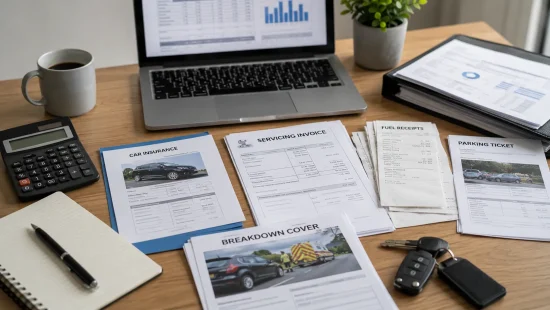
Useful records may include:
- Lease agreement
- Monthly lease invoices or payment records
- Mileage log showing business and private mileage
- Fuel receipts
- Insurance documents
- Repairs, servicing and MOT invoices
- Breakdown cover costs
- Parking receipts for business journeys
- CO₂ emissions evidence for the vehicle
- Notes explaining the purpose of business journeys
For Self Assessment, record keeping is not just about reducing tax. It also helps protect the taxpayer if HMRC asks questions later. Readers dealing with HMRC correspondence may find this guide to HMRC tax letters helpful for understanding why HMRC may contact taxpayers about their affairs.
A simple mileage log should usually include the date, start location, destination, business purpose, miles travelled and whether the journey was business or private. The more mixed the vehicle use, the more important this record becomes.
What Should a Self-Employed Person Do Next?

A self-employed person considering a car lease tax deduction should first check how the vehicle is used. If there is private use, they should work out a fair business-use percentage and keep evidence to support it.
Next, they should check the car’s CO₂ emissions. If the car is over 50g/km, the 15% lease rental restriction may apply to the otherwise allowable business lease cost.
HMRC guidance confirms that the restriction applies to most cars over 50g/km CO₂ and disallows 15% of the otherwise allowable deduction.
They should then compare actual costs with simplified mileage. For 2026/27, simplified mileage for cars and goods vehicles is 55p per mile for the first 10,000 business miles and 25p per mile above that.
Finally, they should keep records throughout the year rather than trying to reconstruct mileage and costs at the end of the tax year. This is especially important where the vehicle is used for both business and personal journeys.
Conclusion
A self-employed car lease tax deduction in the UK can be valuable, but it must be calculated carefully.
The main rule is that only the business-use portion of the leased car should normally be claimed. Private journeys, ordinary commuting, fines and penalties should be excluded.
For the 2026/27 tax year, self-employed people should pay particular attention to the 15% lease rental restriction for cars over 50g/km CO₂, the increased simplified mileage rate of 55p for the first 10,000 business miles, and the difference between leasing a car and buying one.
The best method depends on the vehicle, mileage, CO₂ emissions, lease cost and quality of records. Where the claim is material or unclear, a self-employed person should check HMRC guidance or speak to an accountant before filing their Self Assessment tax return.
FAQs
Can a self-employed person claim car lease payments?
Yes. A self-employed person can usually claim the business-use portion of car lease payments if the car is used for business.
Can a sole trader claim 100% of a leased car?
Only if the car is used wholly for business. If there is private use, the claim should normally be reduced.
What is the 15% lease rental restriction?
It is an HMRC rule that disallows 15% of the otherwise allowable lease deduction for most cars over 50g/km CO₂.
Does private use affect a car lease tax deduction?
Yes. Private use reduces the amount that can be claimed because only business-related costs are normally allowable.
Can self-employed people claim fuel as well as lease payments?
Yes, under the actual cost method, business-use fuel may be claimed alongside other allowable vehicle costs.
Is simplified mileage better than actual car lease costs?
It depends. Simplified mileage is easier, but actual costs may give a higher claim where lease and running costs are significant.
Can electric car lease payments be claimed by self-employed people?
They may be claimable if used for business, but the claim still depends on business use, lease terms and the correct tax method.
Sources
https://www.gov.uk/expenses-if-youre-self-employed/travel
https://www.gov.uk/simpler-income-tax-simplified-expenses/vehicles
https://www.gov.uk/hmrc-internal-manuals/business-income-manual/bim47725
https://www.gov.uk/capital-allowances/business-cars